The Tube Wars: K3-EDTA vs. Cell Stabilization Tubes
Why does a $0.50 tube ruin a $300 test? We break down the chemistry of EDTA vs. Streck tubes and help you decide which one your clinic needs.
The Tube Wars: K3-EDTA vs. Cell Stabilization Tubes
If you look at the catalog for a veterinary reference lab offering liquid biopsy, you will often see two options for sample submission: "Frozen Plasma" or "Stabilized Whole Blood."
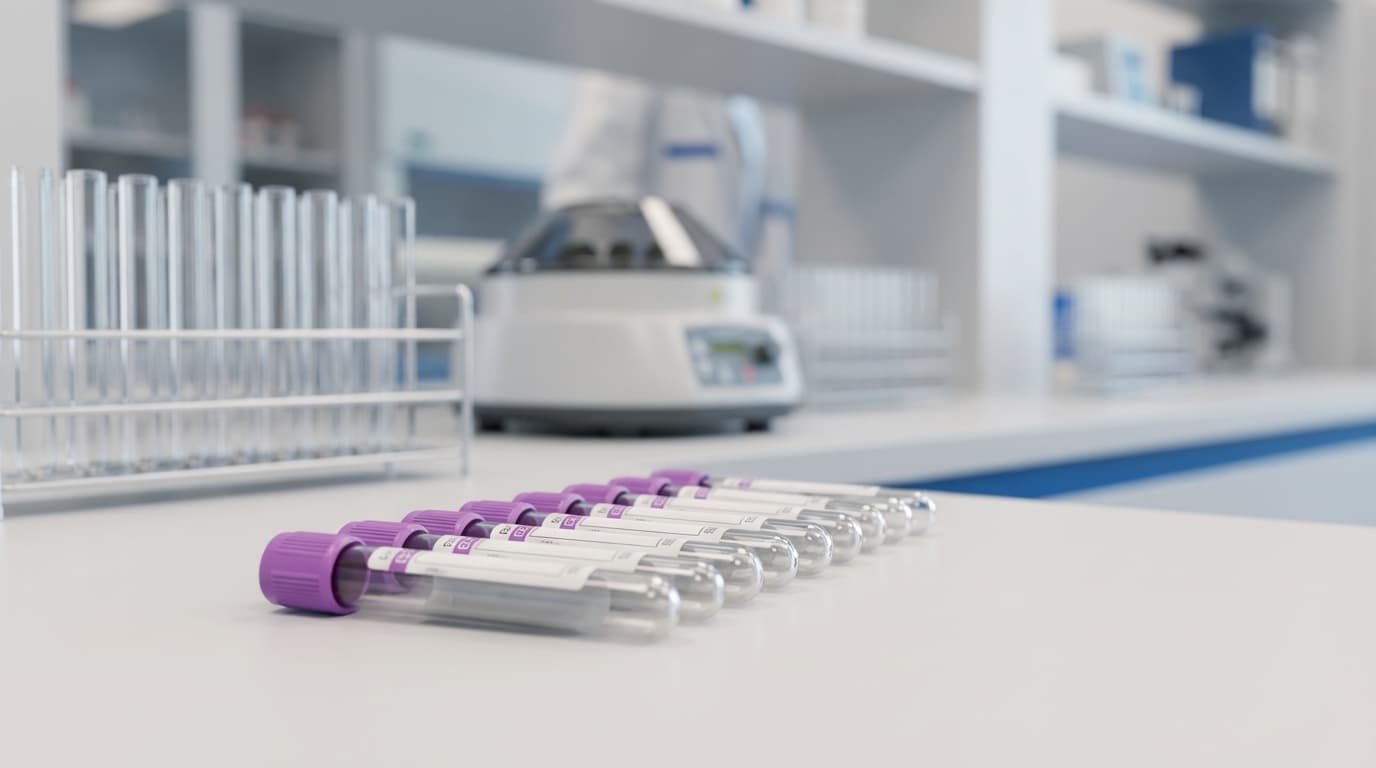
This choice dictates which blood tube you grab: the standard purple-top EDTA or the specialized (and often distinctively marked) Streck Cell-Free DNA BCT.
Why does it matter? Why can't you just mail the purple top like you do for other tests? The answer lies in the fundamental chemistry of what happens inside that tube over time.
Understanding the Challenge
Before we compare tubes, let's understand the problem we're solving. When you draw blood, the white blood cells (WBCs) in that tube are still alive. They're metabolizing, consuming glucose, and eventually—if nothing intervenes—they will die.
When WBCs die in your tube, they release their entire genomic complement into the plasma. This "genomic contamination" swamps the trace amounts of circulating cfDNA you were trying to measure. It's like trying to hear someone whisper at a rock concert.
The tube you choose determines how long you can wait before this contamination becomes a problem.
The Purple Top: K3-EDTA
The Mechanism
EDTA (ethylenediaminetetraacetic acid) acts by chelating (binding) calcium ions. Calcium is a critical cofactor for both the coagulation cascade and for DNase enzymes that degrade DNA. By binding calcium, EDTA accomplishes two things:1. Prevents Clotting: Without calcium, the clotting cascade cannot proceed, so the blood stays liquid.
2. Slows DNA Degradation: Without calcium, DNase enzymes work less efficiently, preserving whatever cfDNA is present.
What EDTA Does NOT Do
Critically, EDTA does not feed, protect, or preserve the white blood cells themselves. The cells are still alive, still metabolizing, and still on their inevitable path toward death.The Timeline of Failure
Draw Time (T=0): WBCs are alive and healthy. The plasma contains only true cfDNA—the signal you want to measure.
T+2 Hours: At room temperature, glucose in the tube is depleting. Cells are becoming stressed. Sample is still acceptable if processed now.
T+4 Hours: The critical threshold. WBCs are under significant metabolic stress. Some fragile cells (neutrophils especially) begin to undergo apoptosis. Membrane integrity is compromised.
T+8 Hours: Widespread WBC membrane rupture (lysis) is occurring. Genomic DNA is flooding into the plasma.
T+24 Hours (Overnight/Mailing): The tube now contains a soup of genomic DNA from billions of lysed WBCs. The original cfDNA signal is completely drowned out.
The Result of Delayed Processing
The trace amount of tumor DNA you wanted to measure is now diluted by a factor of 10,000:1 or worse by healthy genomic DNA. The test is useless—or worse, it may give a "normal" result that misses a cancer because the tumor signal was buried in noise.The Verdict on EDTA
Use EDTA only if you can spin and separate plasma within roughly 2-4 hours of the draw. If you have a centrifuge on-site and can process samples promptly, EDTA is perfectly adequate and very cost-effective.The Specialist: Cell Stabilization Tubes (Streck and Others)
The Mechanism
Streck Cell-Free DNA BCT tubes (and competitors like PAXgene Blood ccfDNA Tubes) contain proprietary preservative agents. While the exact formulations are trade secrets, they generally work by:1. Stabilizing Cell Membranes: The preservative penetrates WBCs and strengthens their membranes, preventing lysis even under stress.
2. Inhibiting Metabolic Activity: The preservative slows cellular metabolism, reducing the rate at which cells consume resources and generate waste.
3. Cross-Linking Prevention: Unlike harsh fixatives (like formalin), these preservatives do not cross-link DNA, which would make it unsuitable for molecular analysis.
Think of it as putting the cells into suspended animation. They're not truly alive, but they're also not falling apart.
The Specifications
* Stability Window: Maintains sample integrity for 7 to 14 days at room temperature (6°C to 37°C, or approximately 43°F to 99°F).
* Practical Benefit: You can draw blood on Monday, ship it Tuesday, have it arrive Wednesday, and the lab can process it Thursday—all without significant genomic contamination.
* Plasma Quality: The preservative keeps the plasma "clean" for cfDNA analysis by preventing cellular DNA release.
The Catches: Important Limitations
1. Cost
These tubes cost significantly more than standard EDTA tubes. While an EDTA tube might cost $0.50 to $1.00, a Streck BCT tube can cost $10 to $20 per tube. For high-volume testing, this adds up quickly.
2. Fill Volume Requirements
Stabilization tubes rely on a specific ratio of blood volume to preservative. If the tube requires 10 mL of blood, you need to draw 10 mL—not 7 mL, not 8 mL. A "short draw" means the preservative concentration is too high relative to the blood, and the chemistry may not work correctly.
* Tip: Check the fill line on the tube before the draw. Know your minimum and maximum volumes.
3. Temperature Sensitivity: NEVER FREEZE
This is the most common and catastrophic error with stabilization tubes.
You cannot freeze whole blood in a Streck tube. The preservative stabilizes cell membranes against metabolic stress, not against ice crystal formation. When you freeze whole blood:
- Water inside cells expands as it freezes
- Ice crystals puncture cell membranes
- Upon thawing, every cell in the tube has lysed
- The sample is 100% hemolyzed and useless
If you put a Streck tube in the freezer, you have destroyed the sample. There is no recovery.
4. Cannot Substitute for Immediate Processing in All Cases
While stabilization tubes are excellent, some ultra-sensitive assays still prefer freshly processed plasma. Check with your laboratory about their specific requirements.
Decision Logic: Choosing the Right Tube for Your Workflow
Scenario A: The Well-Equipped Clinic
* Situation: You have a centrifuge on-site, trained technicians, and can process samples within 2 hours. * Choice: EDTA. Spin it down promptly, harvest plasma using the double-spin protocol, and freeze the plasma. This is the most cost-effective approach, and frozen plasma is stable for months.Scenario B: The 4 PM Friday Draw
* Situation: A client brings in their dog for cancer screening at 4 PM on Friday. The courier has already left. The lab doesn't process over the weekend. * Choice: EDTA. But process it immediately. Spin, harvest plasma, and freeze. The frozen plasma can sit in your freezer all weekend and ship on Monday with dry ice.Scenario C: The Mobile or Ambulatory Practice
* Situation: You're a mobile vet, an equine practitioner in the field, or working in a location without centrifuge access. * Choice: Streck. Draw the blood, label it, keep it at room temperature, and ship it when you get back to civilization. The stabilization buys you the time you need.Scenario D: The High-Volume Busy Clinic
* Situation: You're drawing 10+ liquid biopsy samples per week. Your techs are swamped with other stat spins, and prioritizing cfDNA samples within 2 hours is operationally difficult. * Choice: Streck. It buys flexibility. You can draw at 9 AM and batch-process at 5 PM without data loss. The extra cost per tube may be worth the workflow simplification.Scenario E: Shipping to a Distant Reference Lab
* Situation: Your reference lab is on the other side of the country. Shipping takes 2-3 days. * Choice: Either, depending on your processing capability. - If you can process: Use EDTA, spin, freeze plasma, ship on dry ice. - If you cannot process: Use Streck, ship at room temperature with thermal buffering.Common Mistakes to Avoid
| Mistake | Why It Happens | The Consequence |
|---------|----------------|------------------|
| Mailing EDTA whole blood overnight | Assuming "overnight" is fast enough | Massive WBC lysis, useless sample |
| Freezing a Streck tube | Treating it like plasma | Complete hemolysis, useless sample |
| Short-filling a Streck tube | Difficult venipuncture | Incorrect preservative ratio, unreliable results |
| Refrigerating EDTA whole blood | Thinking cold = preserved | Accelerates certain cellular changes, still lyses by 24h |
Cost-Benefit Analysis
The choice often comes down to economics:
* EDTA Tube: ~$0.50 per tube + technician time for immediate processing + dry ice for shipping frozen plasma.
* Streck Tube: ~$15 per tube + room temperature shipping (no dry ice needed).
If a failed sample means a $200+ retest and a disappointed client, the "expensive" stabilization tube is actually the cheaper option. Calculate based on your volume and workflow.
Summary: Quick Reference
| Feature | EDTA (Purple Top) | Streck BCT |
|---------|-------------------|------------|
| Cost | Low (~$0.50) | High (~$15) |
| Processing Time | Must spin <2-4 hours | Can wait 7-14 days |
| Shipping | Frozen plasma on dry ice | Room temperature |
| Freezing | Freeze the plasma (not whole blood) | NEVER freeze |
| Best For | In-house processing | Field work, delayed processing |
Choose the tube that fits your workflow, not just your budget. A cheap tube that yields a failed test is the most expensive option of all.